2026 Travel Trends: Digital Detox, Family Wellness and the New Retreat Economy
Travel trends can get noisy fast.
Every year brings a new batch of phrases: set-jetting, farm charm, fan voyage, hotel hopping, readaways, “glowmads,” quiet travel, digital detox, sleep tourism, longevity travel — and so on.
Some of it is marketing language. Some of it will disappear by next season. But taken together, the newest travel and hospitality headlines point to something real: people are not just asking where they should go. They are asking what the trip is supposed to do for them.
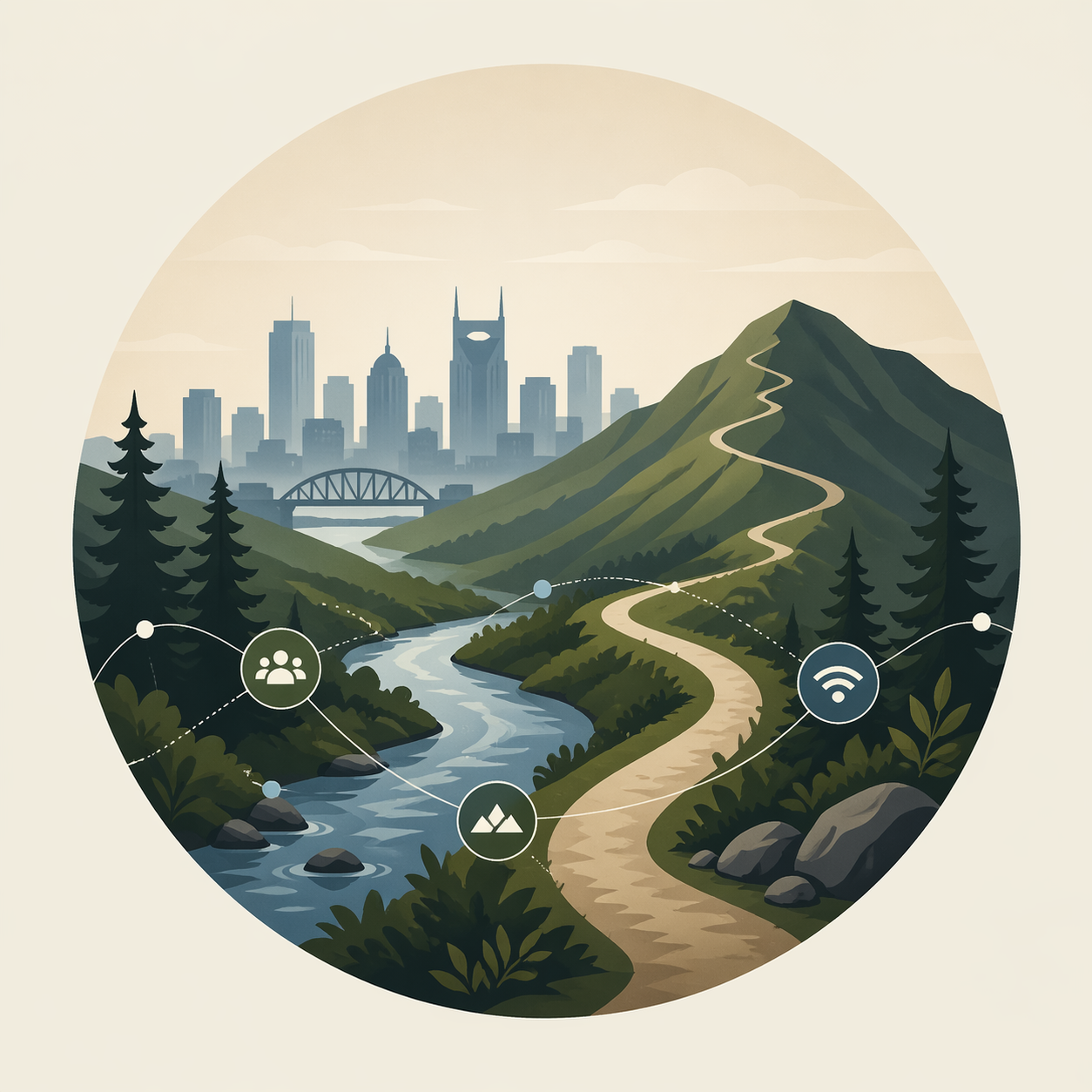
That matters for retreat-style hospitality. It matters for boutique properties. It matters for regional destinations. And it matters for places like Nashville and Middle Tennessee, where the appeal is not just proximity to a major city, but access to music, food, outdoor space, local character and a slower pace when the moment calls for it.
Here is what is worth watching.
1. Quiet is becoming a product
One of the clearest signals in recent travel coverage is the rise of silent retreats, no-phone retreats and digital detox stays.
Reuters recently framed it directly: Gen Z is “paying for silence,” with younger travelers treating silent retreats as part of their wellness spending and a way to find clarity in an anxious economy. The piece also cited McKinsey data showing Gen Z and millennials make up 36 percent of the U.S. adult population but drive more than 41 percent of annual wellness spending.
That is not just a wellness story. It is a hospitality story.
Silence used to be the absence of an amenity. Now, in the right setting, it can be the amenity.
That does not mean every retreat property needs to become a monastery. It means guests are increasingly aware of how overstimulated they are. They may not want a strict silent schedule, but they do want the option to put down the phone, walk outside, sit by a fire, sleep without hallway noise and wake up without being pulled immediately back into the feed.
The operator takeaway: do not oversell “escape” unless the property actually helps people disconnect.
2. “Touch grass” has gone mainstream
Airbnb’s 2026 travel predictions lean heavily into outdoor and nature-driven travel. The company reported that U.S. searches for stays near national parks are up 35 percent, that nature and outdoor experiences are the top booked experience category, and that the “touch grass” social-media movement has more than 85,000 TikTok posts tied to the hashtag.
Expedia’s 2026 trend report points in the same direction through “Farm Charm,” with 84 percent of travelers expressing interest in staying on or near a farm and Vrbo seeing farm-related guest-review mentions jump 300 percent year over year.
The interesting part is not that people like nature. That has always been true.
The interesting part is how nature is being packaged now: as calm, identity, nostalgia, wellness, content, simplicity and status all at once.
A field, trail, porch, creek, garden, barn, dark sky or fire pit can carry more emotional weight than a generic luxury finish. For regional retreat properties, especially in the Southeast, that creates a real opening. The property does not have to look like a national park. It has to give guests the feeling they came for: room to breathe.
3. Wellness is becoming more social — and more family-friendly
Wellness travel used to be marketed heavily as an individual reset: leave the kids, leave the spouse, leave the noise and focus on yourself.
That is changing.
Condé Nast Traveler recently reported that more wellness resorts are opening up to kids, tweens and full families, with properties such as Miraval and Canyon Ranch developing family connection weeks, teen programming and wellness experiences for younger guests. The story framed the shift as part of a broader recognition that health is not only personal, but social and intergenerational.
For retreat hospitality, that is a useful signal.
A property that works for adults only has one market. A property that can accommodate families, multigenerational groups, founder families, reunions, small teams and private gatherings has more ways to stay relevant.
The key is not turning every stay into camp. It is designing spaces where different age groups can have different versions of the same trip. Adults need quiet, comfort and conversation. Kids need room to move. Teens need not to feel trapped. Grandparents need ease. Everyone needs meals, transitions and gathering spaces that do not create friction.
That is harder than it sounds. But it is also where thoughtful operators can separate themselves.
4. Big events are driving travel — but not always predictably
Event travel is everywhere in 2026. Airbnb reported that 65 percent of its top-searched 2026 travel dates and cities align with major global events, including the Winter Olympics, Coachella and the FIFA World Cup.
Expedia’s “Fan Voyage” trend also points to travelers building trips around sports and local fan culture, with 57 percent saying they are likely to attend a regional sporting experience while traveling.
But the World Cup has also shown that event-driven demand is not automatic. ABC News reported that demand across U.S. host cities has been uneven, with some cities seeing upside while others fell short of early hype; the American Hotel and Lodging Association described softer demand tied to travel barriers, rising costs and shorter booking windows.
That is the useful lesson for operators: do not confuse an event with a strategy.
Events can create demand. Hospitality earns it.
Reuters recently highlighted Atlanta’s fan-friendly approach during the World Cup, including affordable food, free Fan Fest access nearby and unchanged transit pricing. The theme was simple: the city and stadium focused on the parts of the guest experience they could control.
For Nashville and Middle Tennessee, that point travels well. Major events can bring people into the market, but the best hospitality opportunities may come from what happens around the event: family add-ons, team gatherings, sponsor retreats, executive hosting, regional side trips, recovery days and quieter stays before or after the main attraction.
5. The staycation economy is not a joke
People still want to travel. But cost is shaping the decision more sharply.
People reported that a 2026 Monster survey found 52 percent of U.S. workers surveyed are opting for staycations this summer because of rising travel and daily-living costs. The same report found nearly 40 percent are cutting back on travel expenses and 28 percent are prioritizing saving money.
This is where regional retreats have an advantage.
A destination within driving distance can feel like a real trip without requiring airfare, rental cars, complicated arrival windows or a week away from work. That does not make the trip cheap. It makes the decision easier.
The strongest positioning is not “nearby.” Nearby can sound ordinary.
The stronger message is: close enough to be easy, far enough to feel different.
That is a much better lane for regional hospitality, especially near a market like Nashville. Guests can leave after work, arrive before dinner and still feel like they crossed into a different rhythm.
6. AI is changing how travelers ask questions
Another trend worth watching: AI is becoming part of trip planning.
Simon-Kucher’s 2026 travel trends report found that 42 percent of travelers used AI-powered tools for itinerary planning in 2025, while 33 percent used them for translation and 31 percent for travel search. The report also noted that more than 60 percent of Gen Z and millennial travelers use AI tools for planning or inspiration.
For hospitality operators, the practical takeaway is straightforward: vague properties will be harder to recommend.
A guest may not search for “boutique retreat property near Nashville.” They may ask an AI tool for:
A quiet place within three hours of Nashville for a 12-person leadership retreat.
A farm-style stay for a family reunion with outdoor space and good food nearby.
A digital detox weekend that still has enough comfort for people who do not camp.
A small retreat venue with privacy, reliable Wi-Fi and space for a long dinner table.
Those are not keywords in the old sense. They are use cases.
The properties that answer those use cases clearly will have a better chance of showing up wherever the planning begins.
Quick hits: other trends worth tracking
Readaways: Expedia and Vrbo report growing interest in reading-focused trips, with Pinterest searches for “book club retreat ideas” up 265 percent and reading-related terms in Vrbo reviews nearly tripling. Read more here.
Hotel hopping: More than half of travelers are booking multiple hotels within a single destination, according to Expedia’s 2026 trend coverage. That matters because travelers may increasingly split a trip by mood: one stay for the city, one stay for quiet. Read more here.
Salvaged stays: Upcycled hotels in former schools, train stations and banks are gaining attention, suggesting travelers want character and a story, not just clean rooms. Read more here.
Set-jetting: Travel inspired by film and television continues to grow, with Expedia reporting that 53 percent of travelers say their desire to take a screen-inspired trip has increased in the past year. Read more here.
Luxury train hopping and ancestry travel: Condé Nast Traveler’s 2026 trends list points to a broader desire for slower, more narrative-driven travel — trips that feel connected to story, identity and place. Read more here.
The throughline
The travel market is not moving in one direction. It is moving in several at once.
People want nature, but they still want comfort. They want wellness, but not always austerity. They want experiences, but not friction. They want to unplug, but they still want the trip to be easy to plan. They want events, but they also want downtime. They want places that feel real.
That is good news for retreat-style hospitality.
The best opportunities are not limited to famous destinations or giant resorts. They are open to properties that understand why people are traveling in the first place.
A retreat is no longer just a place to stay. Increasingly, it is a tool for recovery, connection, celebration, focus, family time, leadership, nostalgia, self-improvement or simply a few days when life feels less loud.
The properties that can name that purpose — and deliver on it without making the guest work too hard — will have the edge.
Further Reading
Reuters: Why Gen Z is paying for silence
Airbnb: 2026 travel predictions revealed
Expedia Group: Unpack ’26 travel trends
Travel Agent Central: Expedia unveils 2026 travel trends and emerging destinations
Condé Nast Traveler: For the first time, these wellness resorts are opening up to kids and tweens
Condé Nast Traveler: The biggest travel trends of 2026
ABC News: How World Cup travel has shaped demand for U.S. host-city stays
Reuters: Atlanta stadium bucks World Cup pricing trend with Southern hospitality
People: 52 percent of people in the U.S. planning for staycation summer, survey finds
Simon-Kucher: From AI tools to wellness retreats — five global travel trends for 2026